
Beyond the Bathroom: Creative Mirror Placement Ideas to Maximise Light and Space
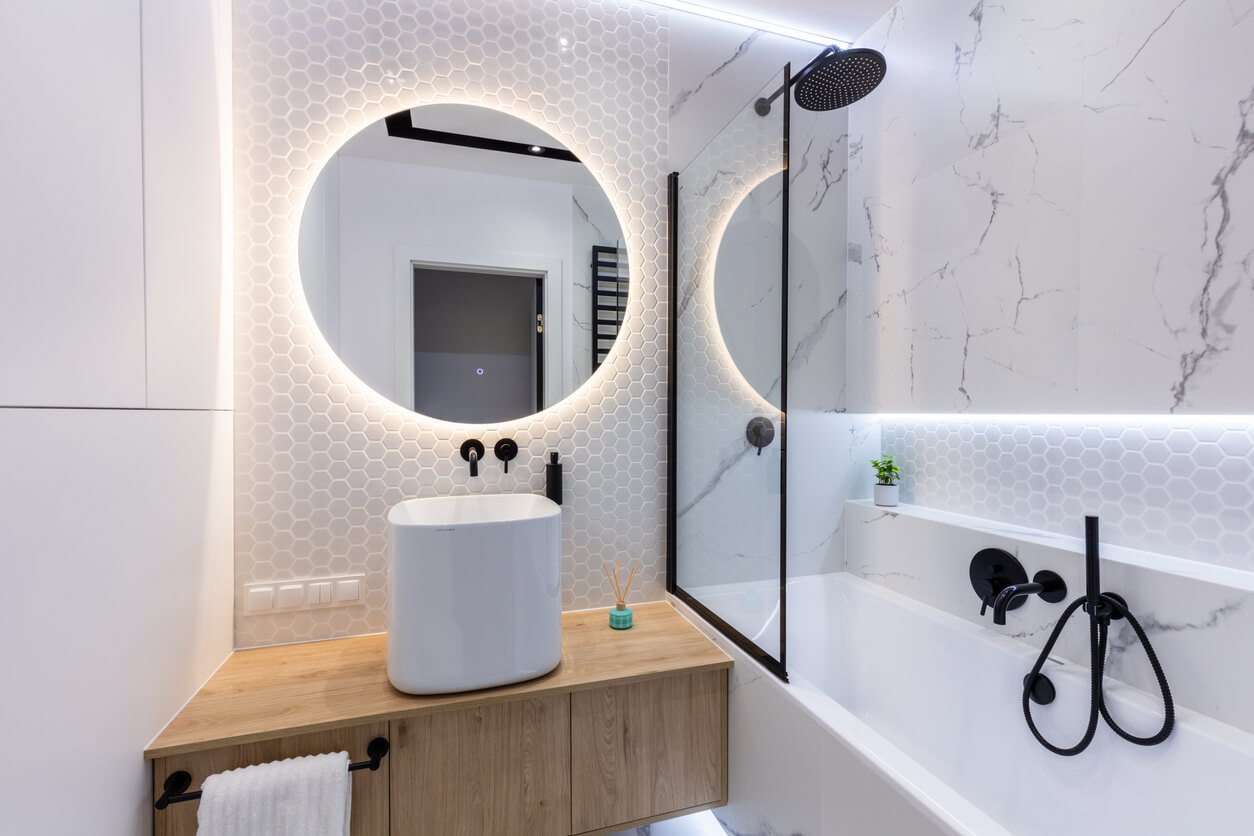
Mirrors are commonly used in bathrooms and bedrooms for practical purposes. But they’re not limited to functional uses and locations — they can also be used in many more unexpected and creative ways.
Mirrors can be used throughout your property to add visual interest, amplify natural and artificial light, and add a sense of space in various creative ways.
There are numerous styles, sizes, materials and shapes to consider, so you won’t be limited in your choice. However, be careful in your selection and placement so you don’t spoil the overall effect. The aim is to fit in with the design elements and architecture of your property, as well as meet your own preferences.
Using Large Decorative Mirrors to Amplify Natural Light
One of the best ways to make any space look better is by brightening it by making maximum use of natural light. This not only improves the appearance of a room but also reduces your reliance on artificial light and so lowers your energy costs. But to do this effectively using mirrors, you need to place them properly.
To place mirrors effectively to amplify natural light, you need to understand how light works and how mirrors will react with it. Light always travels in straight lines and reflects from an object at the same angle it strikes it. You need to place your mirrors so the light reflects into the darkest areas for the greatest benefit. Obstructions and their colour, as well as distance, all cause light to be lost, so you need to allow for this.
Place a mirror directly opposite a window to capture the natural light or at an angle to the window to reflect the light into a required area. Putting a mirror near a table lamp or ceiling light will increase the effect. The proper positioning of mirrors can transfer light all around a room if done with some thought.
Most mirrors have clear glass, but you can use smoked glass for an intimate feel and have mirrors with metallic frames that will also reflect and add interest. Mirrors with a convex shape disperse light more widely, while concave ones will concentrate the light into required areas.
Strategic Placement in Hallways and Dining Rooms
Hallways can sometimes be dark places, but they are often the first part of your home that visitors see, so you want to make them as inviting as possible. Mirrors placed in hallways and dining rooms can have several purposes — they reflect natural light and make the room seem brighter, they make the space appear bigger, and they can be highly decorative with the correct choice. But you need to place them strategically to achieve the best effect.
Placing mirrors opposite each other can create an infinity effect, while an ornate mirror gives a grander feel to any room. Mirrors can be fixed or movable, enabling them to be repositioned for different uses.
In narrow and possibly dark places such as hallways, a mirror can give the impression of increased size and brightness. Especially for rooms with only one natural light source, align the mirror with the centre of the window so you capture both direct and ambient light. Large mirrors with minimal or bevelled frames will amplify this effect.
Putting a mirror behind a light source, such as a table lamp, gives the impression of an additional light source and increases brightness. And rather than placing a mirror flat against a wall, a corner location may work better in distributing natural light throughout the room. Smoked or antique-effect mirrors will do this in a gentler manner.
Avoid placing mirrors so they reflect something that is unattractive or distracting. Instead, use them to showcase pieces of art or various design features. In general, place mirrors at eye level, usually 57-63 inches from the floor, and ensure they reflect a room’s attractive features.
Placed properly, mirrors can help well-being by making spaces seem lighter and brighter. So it’s important you test out the placement before finalising it.
The Visual Impact of Frameless vs. Framed Mirrors
Mirrors come in a wide variety of sizes and styles, so there’s certain to be something that meets your needs. Ornate, gilded-framed mirrors are best suited to traditional styles of rooms, while those with minimalist frames or no frames at all are better for modern settings.
A mirror’s frame will complement your décor, and a frameless version will help to support a minimalist theme. Asymmetrical frames are becoming more popular, and the frames can be paired with adjacent fixtures for a common theme.
Certain frames work well in different rooms. Iron, brass and wood will create different themes while frameless mirrors combine style with functionality.
Securing Different Mirror Shapes (Circular, Organic, Rectangular)
Mirrors are available in a variety of shapes and sizes, and you can use them separately or in a group to create the effect you want. You can create a gallery wall of different mirrors, but take care not to overdo the effect and cause confusion and a lack of balance.
Different mirror shapes present varying hanging challenges, while very large and heavy mirrors need substantial support. Rectangular or square mirrors are the easiest to hang because the weight is distributed evenly. For round and oval mirrors, weight is distributed differently, and there are no straight edges to align with wall studs. Arched mirrors require careful support because the arched top can cause a sense of imbalance, while mirrors with irregular shapes present complex challenges.
You need to know your type of wall because brick and solid wood will provide firm support, but plasterboard and drywall will require wall anchors or toggles for heavy mirrors. Also, check the wall for weakness because cracks and other damage will not hold fasteners properly.
Screws can be driven directly into wall studs, while plugs and heavy-duty anchors are required in other cases. Mirror clips and cleats will generally ensure a tight and secure fit, but you must check the weight ratings on the fastenings and ensure these are adequate for the weight of the mirror.
Failure to fix your mirror correctly can result in a crooked appearance. Even worse, there’s the danger that it may fall from the wall and cause damage and injury. It’s vital your mirrors are hung securely, so get in touch with the team at All About Hanging, and we’ll ensure this is the case. Our professional mirror hanging services ensure proper placement for optimal light reflection and secure installation, regardless of mirror size, shape, or wall type.