
Solving Uneven Surfaces: Hanging Artwork on Slanted Ceilings and Staircases
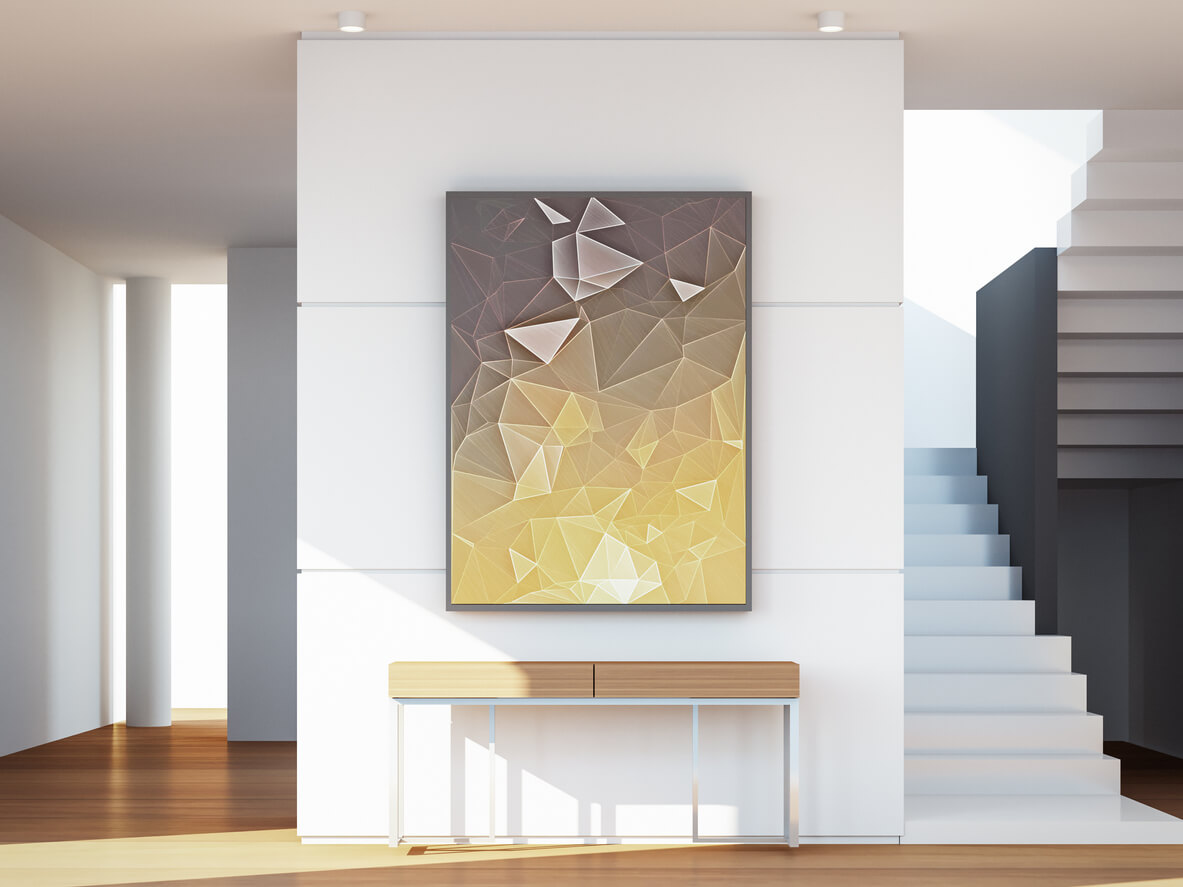
Hanging artwork in a room with level ceilings is relatively straightforward. However, if you want to put up artwork on a staircase or in a room with a sloping ceiling, it’s not as easy.
The problem with a slanted ceiling is that your eye tends to follow the line of the ceiling, and any artwork on the wall will not look straight in comparison to it. Even though it is perfectly level, your mind will tell you that it isn’t.
A staircase provides a similar challenge because of its slope and the possibility of landings with varying wall sizes and angles. However, with careful planning and some imagination, you can treat the staircase or sloping ceiling as an opportunity to showcase your art in an unusual manner. You can create a balanced display that flows naturally, drawing the eyes upwards or downwards in line with the artwork.
Techniques for Achieving Level Art on Difficult Angles
The presence of angled ceilings and irregular sections of wall with different contours means that you can develop a display that shows your creativity and keeps the eye moving. The trick is to use the angles and irregularities to create a unique display that flows naturally.
Staircases in particular are all different, with varying wall heights and awkward spaces. Narrow pieces work best in tight spaces, while multiple pieces can be arranged in a grid on wider walls.
Before you start drilling holes or hammering in nails, it’s best to assess how your artwork will look. Make a paper template for each piece and temporarily tape it to the wall in the desired place. You can then stand back and see the effect, making adjustments before fixing your artwork properly. You can experiment with different sizes and shapes in varying combinations before deciding which works best.
To help you line up your artwork correctly on a staircase, mark a point sixty inches (150 centimetres) above the first and last step, then connect those points with masking tape. This gives you a guideline that you can follow when arranging your artwork.
Hang a large picture at the centre of the line and then work outwards with smaller pieces, which can be placed at the centre point of each step. As a general rule, allow 10-15 centimetres vertically and horizontally between frames so they are not too close. You can arrange in lines or grids with a mix of sizes and shapes, depending on the space available.
To do the job properly, you’ll need a tape measure and a pencil for marking positions and a spirit level for correct alignment. A hammer and picture hooks or nails will be adequate for smaller pictures, but you’ll need a drill, screwdriver and plugs or anchors for anything heavier. You may also need a wall scanner to make sure you don’t put screws or nails into pipes or cables.
Calculating Visual Height on a Staircase Wall
The standard method of calculating visual height is to make a mark at intervals for each step that is approximately at eye level (60 inches or 150 centimetres). Joining the marks with masking tape then sets a diagonal guideline that follows the line of the staircase.
The aim is then to hang your pieces of artwork along the line. You can align to the centre of each piece, or to the top or bottom, depending on the size. This ensures that each piece is at a comfortable level for viewing when anyone walks up or down the stairs.
Getting the right spacing between pieces will avoid a cluttered look and ensure each piece relates properly to its neighbour. You can use various sizes and shapes of frames, but you should aim to align them with stair risers, so they are balanced and guide the eye smoothly.
Specialist Fixings for Unique Architectural Challenges
When hanging normally, light pieces of artwork can usually be supported by hooks or nails, provided the wall is substantial. Heavier pieces require plugs or anchors to hold screws in the walls. For sloping walls and staircases, however, specialist fixings are often necessary.
String or wire can often be used to create adjustable hanging points along angled walls. This method gives great flexibility by allowing frames to be clipped or hooked at different heights and positions. Movements caused by bumps or environmental changes are better absorbed, and artwork can easily be changed.
Angled hangers and pivoting hooks are also useful, allowing artwork to be aligned with the viewers’ line of sight. If you live in a rented property, mounting strips and adhesive hooks won’t damage the walls and will allow easy repositioning.
Whether using wire or hooks, two nails or screws to each picture will help to keep it level, while keyhole hangers are useful on sloping walls. The latter requires a screw to be put in each corner of the frame and then fitting these into the corresponding keyhole hangers on the wall for a secure fix. As with any artwork hanging, really heavy pieces require a firm fix to hold them safely.
Maximising Visual Appeal in Non-Traditional Spaces
Lighting, whether natural or artificial, can play a big part in emphasising the appeal of certain artwork. Spotlights will create focal points, while shadows can add impact.
Artwork with clear lines and simple frames will enhance a minimalist look, and black and white prints will provide sophistication. You can have groupings of artwork with a common theme or mix styles for character.
Refresh the display by rotating the artwork or simply changing the frames. Different frames give varying impressions — wood for warmth and metal for sophistication. Small shelves among the pictures will also allow the display of other objects.
Slanting ceilings and staircases should be seen as an opportunity rather than a problem. With a little thought and imagination, you can achieve an impressive display. But, if you’re at all concerned about doing that successfully, get in touch, and we’ll ensure you make the best use of your space, no matter how awkward it is. For professional picture and art hanging in challenging spaces with slanted ceilings or staircases, All About Hanging has the expertise to create beautifully balanced displays that work with your unique architectural features.